

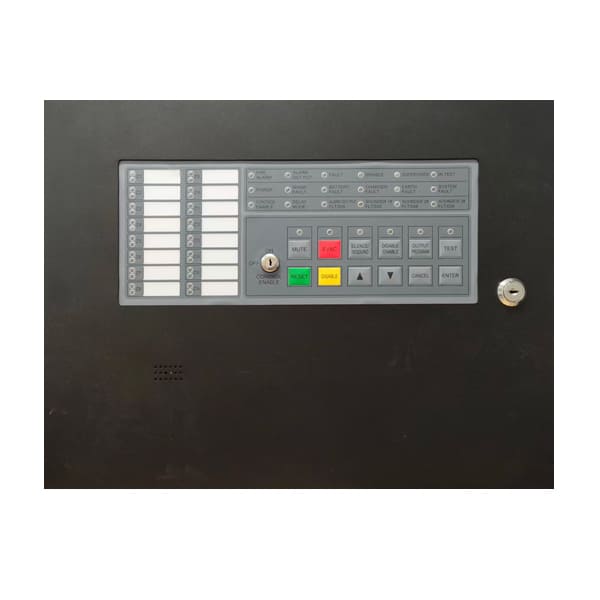
Conventional Fire Alarm Control Panel Max 16 Zone

The Tanda TXC7000 Series Conventional Fire Alarm Control Panels are available in 2-, 4-, 8-, and 16-zone models. They monitor compatible conventional smoke detectors, heat detectors, and manual call points, identify the affected zone, and activate the configured sounder circuits.

Brand:
Tanda UK
SKU:
TXC7016
Certification:
CE, CPR, TUV
Capacity:
≤32 / zone
Zones:
16 Zones, 2 Zones, 4 Zones, 8 Zones
16-zones
16-zones
2-zones
2-zones
4-zones
4-zones
8-zones
8-zones

Conventional Fire Alarm Control Panel Features

1, Up to 16 zones can be detected, compatible with conventional detectors and manual call points. Each of the 16 zones can be individually configured as maximum 15 conventional detectors. The total number of detectors and manual call points in a zone shall not exceed 32.
2, Three sounder outputs, one alarm output, one fault output and one disable/supervisory output.
3, Able to report short and open circuits of zones, sounder outputs and alarm output.
4, Test and disable functions.
5, Programmable on manual call point connection, sound modes, sounder delay modes and output delay modes.
6, Three access levels settable via the key switch and the internal switch.
7, Providing external ports includes RESET, EVAC, SILENCE.
8, Designed with standby batteries and space provision for two sealed lead-acid batteries.

Technical Specifications

Input Voltage: 100V~230VAC(+10%-15%), 50/60Hz
Input Current: 1.2 A
Fuse: 250VAC, T2A in SPS
Recommended Wiring: 1.5mm2 or above shield cable, complying with local installation codes.
Note: External overcurrent protection device is required and should be installed near the
Operating Voltage:
 Minimum Operating Voltage: 21.5V
 Maximum Charging Current: 350mA
 Maximum Charging Voltage: 27.6V
 Battery Type: Sealed lead-acid battery
 Maximum Battery Charging Capacity: 2 batteries, 7Ah/12V.
Recommended Battery Manufacturer and Model: Yuasa NP7-12
 Maximum internal resistance of the batteries: 1Ω
 Standby current of batteries when fully load: 0.1A
 Maximum operating current of the batteries: 2.1A
Detection Zone:
The FACP provides maximum 16 zones; each can be individually configured with maximum 15
conventional detectors.
Output voltage: 18VDC~28VDC
 Standby current: less than 6mA (connecting with 15 conventional detectors)
 Alarm current: about 25mA
 End-of-line-resistor: 4.7kΩ
 Resistance range for fire alarm: 150Ω~1.5kΩ (normally 510Ω)
 Recommended wiring: 1.0mm2 or above shield cable, complying with local installation codes.  Recommended cable length: no longer than 1000m
Output Interface:
 Fault output
 Type: normally open/close contact output
 Contact capacity: 1A/24VDC
 Disable/supervisory output (defaulted disable output)
 Type: normally open/close contact output
 Contact capacity: 1A/24VDC
 Alarm output
 Type: voltage output, normally open/close contact output are available (defaulted voltage output)
Contact capacity: 1A/24VDC
 Output voltage: 18VDC~28VDC
 Output current: 300mA in alarm
 End-of-line-resistor: 4.7kΩ
 Sounder 1# output
 Type: voltage output, normally open/close contact output (defaulted voltage output)
 Contact capacity: 1A/24VDC
 Output voltage: 18VDC~28VDC
 Output current: 300mA in alarm
 End-of-line-resistor: 4.7kΩ
 Sounder 2#~3# output
 Type: voltage output
 Output voltage: 18VDC~28VDC
 Output current: 300mA in alarm
 End-of-line-resistor: 4.7kΩ
 Auxiliary Power Output
 Output voltage: 18VDC~28VDC
 Output current: 20mA in standby and maximum 500mA in alarm
 Recommended wiring: 1.0mm2 or above shield cable, complying with local installation codes.  Recommended cable length: no longer than 1000m
Input Interface (For future use)
 RESET/EVAC/SILENCE input
 Type: normally open contact input
 Recommended wiring: 1.0mm2 or above shield cable, complying with local installation codes.  Recommended cable length: no longer than 1000m
Installation and Storage
The FACP is applicable for indoor use below the elevation of 2000m. Overvoltage level is Class II and
pollution degree is 2.
Installation Environment
Temperature: -5℃~50℃, Relative humidity≤95%, non-condensing
Storage Environment: Temperature: -25℃~50℃, Relative humidity≤95%, non-condensing

PRODUCT & TECHNICAL SUPPORT

Conventional Fire Alarm Control Panel Max 16 Zone FAQs

Frequently asked questions about this product, configuration, compatibility and technical requirements.

01. What are the TXC7002, TXC7004, and TXC7008 fire alarm control panels?

They are conventional fire alarm control panels that monitor initiating devices by zone and provide visual and audible indications for fire, fault, power, disabled-zone, and output conditions.

02. Are the TXC7002, TXC7004, and TXC7008 addressable fire alarm panels?

No. They are conventional panels, so they identify the affected zone rather than reporting an individual device address.

03. How many zones do the TXC7002, TXC7004, and TXC7008 support?

The TXC7002 supports 2 zones, the TXC7004 supports 4 zones, and the TXC7008 supports 8 zones.

04. Is a TXC7016 16-zone conventional fire alarm control panel available in this series?

A TXC7016 configuration is not confirmed in the available product information, which identifies 1-, 2-, 4-, 8-, and 12-zone models. Request the current TXC7016 datasheet and model confirmation before specifying or ordering a 16-zone panel.

05. How many devices can be connected to each zone?

Each zone supports up to 30 compatible front-end devices. The final device mix and circuit loading must also comply with the approved system design and the electrical requirements of the connected devices.

06. Which conventional fire alarm devices can be used with these panels?

The series is intended for compatible conventional devices such as smoke detectors, heat detectors, manual call points, and alarm notification devices. Confirm circuit voltage, alarm characteristics, end-of-line supervision, and approval compatibility for every selected device.

07. How many bell and auxiliary power outputs do the panels provide?

The TXC7002 provides one bell output and one auxiliary power output. The TXC7004 and TXC7008 each provide two bell outputs and two auxiliary power outputs.

08. What is the rated current of each bell and auxiliary output?

The V1.0 documented configuration rates each bell output and each auxiliary power output at 0.3 A. Some current product information lists 0.5 A, so confirm the exact supplied panel version before calculating the output load.

09. What fire alarm output options are available?

The panel provides one configurable fire alarm output that can operate as a 24 VDC active output or as a passive normally open or normally closed contact, depending on the approved jumper configuration.

10. Does the panel provide a fault relay output?

Yes. The series provides one normally open and normally closed fault relay output with a documented rating of 30 VDC at 2 A.

11. What main power supply do these conventional fire alarm panels require?

The V1.0 documented configuration specifies 100 to 242 VAC at 50 Hz with a maximum operating current of 2.2 A. Current product information lists 187 to 242 VAC and 2.8 A, so verify the nameplate and current datasheet for the supplied version.

12. What backup battery is used in the TXC7 conventional panels?

The documented configuration uses a 12.8 V, 4 Ah lithium iron phosphate rechargeable battery pack for backup power.

13. How long will the backup battery operate the panel?

A fixed standby duration is not confirmed because operating time depends on the selected panel, connected load, alarm load, battery condition, and required reserve period. Calculate and verify battery autonomy for the approved project design and applicable local requirements.

14. Do the panels have a test mode?

Yes. Test mode allows the panel to receive a fire signal and indicate the alarm state while the fire alarm output and sounder outputs remain inactive. Qualified personnel should control its use and restore normal operation after testing.

15. Can a zone or output be disabled for service work?

Yes. The panel can disable selected zones and functions, including the fire alarm output and sounder outputs. Disabled functions cannot provide their normal response, so only authorized personnel should use this feature under the approved service procedure.

16. Does the panel support a fire alarm output delay?

Yes. The documented delay mode postpones the fire alarm output and sounder outputs for 30 seconds after the panel enters the fire state. Use this function only where the approved fire strategy and applicable local requirements permit it.

17. Can the sounders be activated manually from the panel?

Yes. The panel includes an evacuation control that starts the connected alarm bell or visual alarm outputs, subject to the configured system and authorized operating level.

18. What access control is provided for panel operation?

The key switch provides two operating levels. Basic muting is available at Level 1, while functions such as silence, evacuation, test, delay, disable or enable, reset, and self-check require Level 2 access.

19. What are the panel dimensions and enclosure rating?

The documented enclosure measures 311 × 60 × 251 mm, weighs approximately 1.5 kg, and has an IP30 rating. It is designed for wall mounting.

20. What operating environment is specified for the panels?

The specified operating range is 0°C to +40°C with relative humidity up to 95% without condensation. The IP30 enclosure requires a suitable indoor location protected from moisture, excessive dust, heat, and direct sunlight.

21. Can the TXC7002, TXC7004, or TXC7008 connect to a repeater or panel network?

The documented terminals include an RS485 connection marked as reserved, but no repeater or panel-networking function is confirmed. Do not specify remote communication or networking without current written confirmation for the exact panel version.

22. Are these conventional fire alarm panels EN 54 certified?

Product information describes the series as designed according to EN 54-2, but that statement does not by itself confirm third-party certification or the complete approval scope. Request the applicable certificate for the exact model, version, and destination market when certification is required.

23. How often should the panel and backup battery be maintained?

Manufacturer guidance recommends a monthly backup-power discharge check and suggests replacing the backup battery every three years. These are product recommendations only; actual inspection, testing, charging, and replacement must follow applicable local regulations, the approved system design, site conditions, battery condition, and the approved maintenance plan.

Free Preliminary System Drawings

Working on a project budget without a system layout? FireMarket provides free preliminary drawings to help you estimate equipment quantities and costs.

Request Free Preliminary Drawings

Related Products