
What Is a Toxic Gas Detector? Types, Working Principle and Selection Guide
A toxic gas detector is a safety instrument designed to measure harmful gases in the air and warn people or a control system when concentration reaches a configured level. Unlike a smoke detector, it responds to a specific gas or gas family rather than visible combustion products.
Toxic gas detection is used in petrochemical plants, steel works, wastewater facilities, laboratories, battery rooms, cold storage, confined spaces, and other locations where a leak or process release could threaten workers. The correct detector depends on the target gas, expected concentration, environmental conditions, certification, and required alarm response.
How Does Toxic Gas Detection Work?
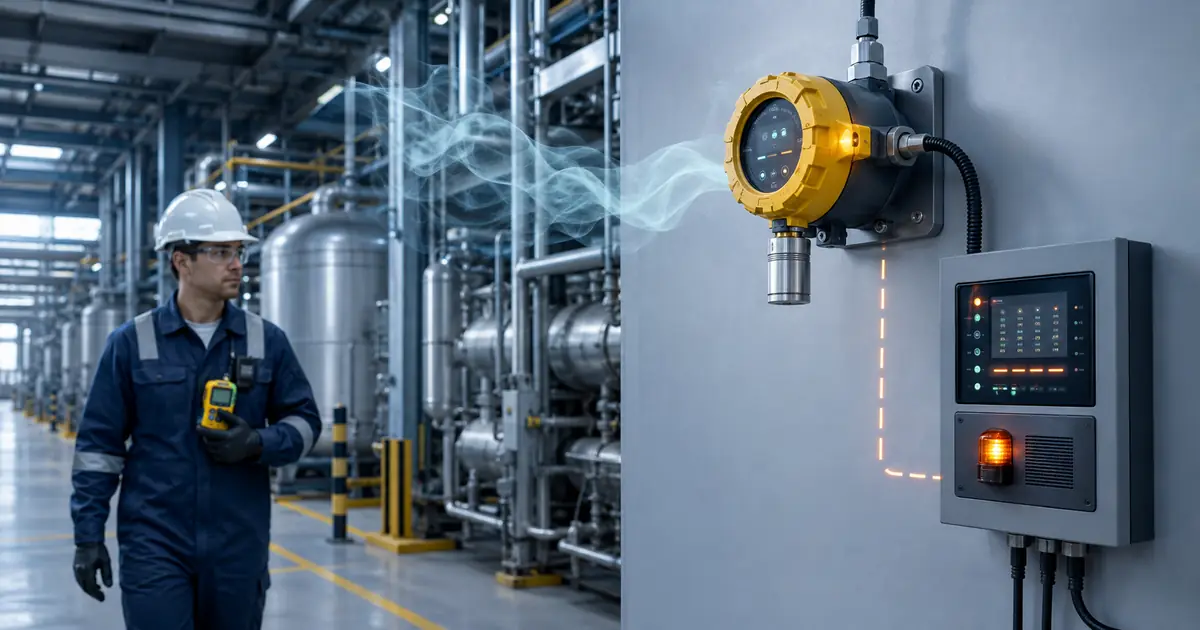
Air reaches the sensor by diffusion or through a pump. The sensor converts the presence of the target gas into an electrical signal, and the instrument calculates a concentration—commonly shown in parts per million (ppm) or percent by volume.
When the measured value crosses a programmed threshold, the detector may activate audible, visual, and vibration alarms. A fixed detector can also transmit its reading to a gas alarm panel, PLC, DCS, ventilation system, or emergency shutdown circuit.
The complete protection system therefore includes more than the sensing head: power, signal transmission, alarm logic, output devices, calibration, testing, and emergency procedures all matter.
Toxic Gas Detector vs. Combustible Gas Detector
| Item | Toxic Gas Detector | Combustible Gas Detector |
|---|---|---|
| Main purpose | Reduce exposure to poisonous gases | Warn before a flammable atmosphere approaches ignition risk |
| Typical unit | ppm or % volume | %LEL |
| Common gases | CO, H2S, NH3, Cl2, SO2, NO2 | Methane, propane, hydrogen and solvents |
| Common sensor | Electrochemical, PID or infrared depending on gas | Catalytic bead, infrared or semiconductor |
Some multi-gas instruments monitor toxic gas, oxygen, and combustible gas simultaneously. However, one sensor cannot be assumed to detect every hazard. The specified gas list, measuring range, cross-sensitivity, response time, and certification must be checked for each configuration.
Common Toxic Gases
-
Carbon monoxide (CO):
produced by incomplete combustion; colorless and difficult to recognize without an instrument. -
Hydrogen sulfide (H2S):
associated with oil and gas, wastewater, sewers, and some industrial processes. -
Ammonia (NH3):
used in refrigeration, fertilizer, chemical processing, and food facilities. -
Chlorine (Cl2):
used in water treatment and chemical production. -
Sulfur dioxide (SO2) and nitrogen dioxide (NO2):
may occur in combustion, processing, and industrial emissions. -
Volatile organic compounds (VOCs):
a broad group often measured with photoionization detection; the response depends on the compound and lamp energy.
Selection note: Do not select a detector from the gas name alone. Expected background, alarm setpoints, maximum release concentration, oxygen level, temperature, humidity, pressure, and interfering gases can all affect the choice.
Fixed vs. Portable Toxic Gas Detectors
Fixed Detectors
A fixed detector provides continuous monitoring at a defined location. It is normally installed near credible release points or where gas may accumulate, then connected to a controller or plant system. Fixed equipment suits permanent risks, automated ventilation, remote indication, and shutdown logic.
Portable Detectors
A portable detector travels with the worker. It supports personal exposure monitoring, pre-entry testing, leak checks, and confined-space work. Depending on the model, alarms may include sound, light, vibration, TWA, STEL, low, and high thresholds.
The two formats are complementary. A fixed system monitors selected areas continuously, while a portable device follows the person and can test locations outside the fixed network.
Sensor Technologies
Electrochemical Sensors
Electrochemical sensors are widely used for gases such as CO, H2S, NH3, Cl2, SO2, and NO2. They are compact and sensitive at ppm levels, but service life, temperature limits, humidity, and cross-sensitivity vary.
Photoionization Detectors (PID)
Photoionization detectors (PID) respond to many VOCs. They are useful for broad screening, but readings require the correct response factor and do not automatically identify an unknown compound.
Infrared Sensors
Infrared sensors can measure selected gases by light absorption. They may provide good stability for suitable targets, but the optical wavelength and gas characteristics must match.
Catalytic Combustion Sensors
Catalytic combustion sensors are primarily used for combustible gases in %LEL. They require oxygen and can be affected by poisoning or high gas exposure, so they should not be confused with a general toxic-gas sensor.
How to Select a Toxic Gas Detection System
Start with a documented hazard assessment, then confirm:
- Target gas or gas mixture and the reason for monitoring it.
- Required measuring range, resolution, low/high alarms, TWA, and STEL.
- Fixed, portable, diffusion, or pump-sampling format.
- Response time and acceptable transport delay.
- Temperature, humidity, dust, water, corrosive atmosphere, and cross-sensitivity.
- Hazardous-area approval, ingress protection, and local regulatory requirements.
- Output interface such as 4–20 mA, RS485, relays, HART, or a manufacturer bus.
- Calibration gas, bump-test method, sensor replacement, and maintenance access.
For industrial projects, compare the detector, controller, field wiring, alarm devices, and cause-and-effect logic as one system. FireMarket’s
industrial product portfolio
can be used as a starting point when defining the required architecture.
Detector Placement
Place sensors from the release scenario—not from gas density alone. Review leak sources, ventilation, air movement, process temperature, obstructions, occupied areas, and maintenance access.
A lighter-than-air gas may rise, while a heavier gas may collect low, but heat, pressure, ventilation, and equipment geometry can change the actual path.
The final layout should be prepared or approved by a qualified designer and checked against applicable codes, standards, manufacturer instructions, and the site risk assessment.
FireMarket Product Examples
ACTION AEC2232bX Fixed Gas Detector
The
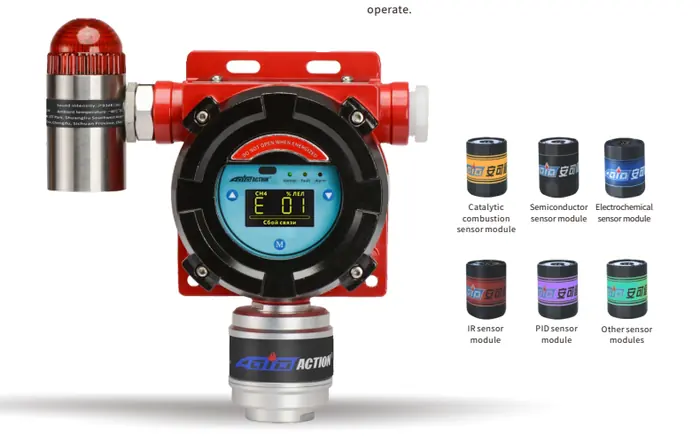
AEC2232bX series
supports configurations for combustible, toxic, and hazardous gases. Published options include catalytic, semiconductor, electrochemical, infrared, and PID sensing; diffusion sampling; IP66 protection; field display; and several signal-output choices.
The exact gas, range, material, certification, and interface must be selected for the project.
ACTION BT-AEC2387 Portable Toxic Gas Detector
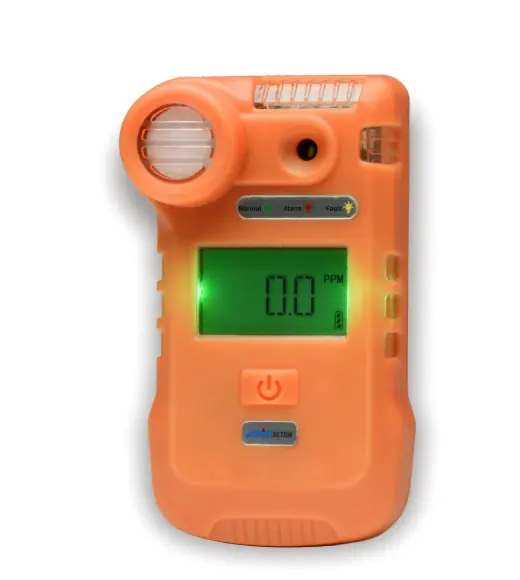
The BT-AEC2387 is a compact diffusion-type portable detector offered for gases including CO, H2S, NH3, and Cl2.
The supplied catalog lists an IP66 enclosure, audible/visual/display/vibration alarms, at least eight hours of continuous operation, and an Ex ib IIC T4 Gb explosion-protection marking.
Available sensor and range combinations should be confirmed at quotation stage. FireMarket represents
ACTION and other gas-detection brands.
Frequently Asked Questions
Can One Toxic Gas Detector Detect Every Gas?
No. Sensors are selected for particular gases or response groups. Multi-gas devices combine several sensors, but their configured gas list remains limited.
What Is the Difference Between a Bump Test and Calibration?
A bump test exposes the detector to gas to confirm that the sensor and alarms respond. Calibration applies a known concentration to adjust or verify measurement accuracy according to the manufacturer’s procedure.
How Often Should a Detector Be Tested?
Follow the manufacturer, site risk assessment, regulations, and company procedure. The interval depends on sensor technology, exposure, environment, criticality, and operating history.
Plan Your Gas Detection Project
Effective toxic gas detection begins with the hazard, not the device. Define the gas, concentration range, release points, environment, approvals, alarm strategy, and system interfaces before choosing a model.
Need help comparing a fixed or portable solution?
Contact FireMarket
with the target gas, measuring range, installation area, required certification, quantity, and controller interface.