


LPCB Ceiling Mount Smoke Detector

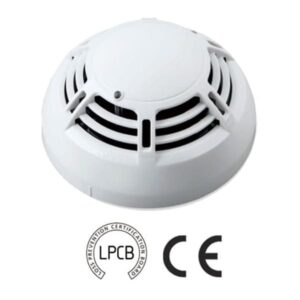
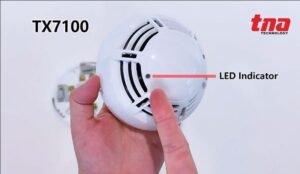
The TX7100 Intelligent Addressable Optical Smoke Detector delivers a swift, linear response to a wide range of smoke patterns and meets the sensitivity requirements of the European standard EN 54 Part 7. Its unobtrusive design complements modern building interiors.

Brand:
Tanda UK
SKU:
TX7100
Certification:
CE, CPR, LPCB
Remote LED:
Yes

TX7100 Fire Detection in a Real Building

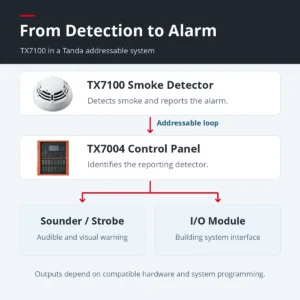
Follow a fire-alarm example from a ceiling-mounted TX7100 detector to a TX7004 control panel and selected programmed outputs.

TX7100 detector linked to TX7004 and alarm output devicesAn illustrated room with smoke rising to a ceiling-mounted smoke detector, a wired signal to the TX7004 control panel and optional connections to a sounder strobe and an input output module. Protected room TX7100Optical smoke detector Fire alarm controlTX7004Fire Alarm ControlDevice 023 (example) Addressableloop signal Programmed outputs Sounder / strobe Audible & visual I/O ModuleBuilding interfacee.g. HVAC / doors Room and system drawing is schematic; equipment appearance and placement are illustrative.
Normal monitoring: TX7100 monitors for smoke.

Alarm point example. Device 023 in the demo is the TX7100 assigned to the Level 2 Office Corridor. During commissioning, a technician checks that the panel reports address 023 when that detector is tested.

This is a conceptual example, not a commissioning test. Devices and outputs shown are optional examples; activation depends on compatible hardware, wiring, cause-and-effect programming and local design requirements. No alarm transmission or response times are specified.

TX7100 Addressable Optical Smoke Detector

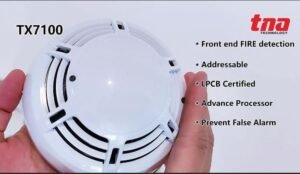
The TX7100 is a ceiling-mounted point smoke detector for compatible Tanda addressable fire alarm systems. Its optical chamber detects smoke particles, and the onboard processor evaluates the signal and reports detector status over the wired addressable loop.

With a compatible panel such as the TX7004, the detector’s programmed address helps operators identify which point reported an alarm.

TX7100 ceiling-mounted optical smoke detector

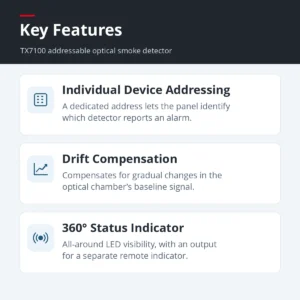
Key Features

Swipe to see more features

Individual Device Addressing

Assign a device address so the compatible control panel can identify and monitor the detector as an individual point.

Drift Compensation

The detector compensates for gradual changes in the optical chamber’s baseline signal, such as those associated with dust buildup.

360° Status Indicator

One onboard LED provides all-around status visibility. A remote indicator output is available when a separate indication point is needed.

Expand Your Detector with the TX7302 Sounder Strobe Base

A compatible detector can be mounted on the TX7302 to add an audible warning and supplementary LED indication at the detector location.

Detector Photo
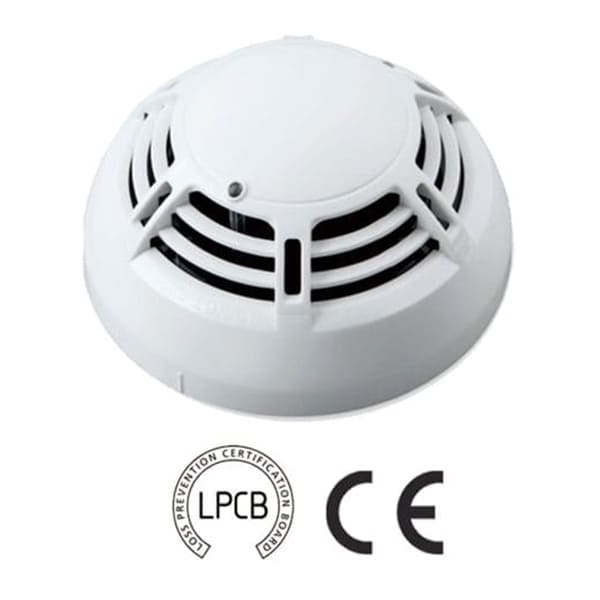
TX7100 smoke detector

Detection + local warning

Where to Use the TX7100

Swipe to see more applications

Office corridor beside glass meeting rooms

Office Corridors & Lobbies

Use addressable point detection where the building team needs to identify the individual detector reporting an alarm.

Hotel guest corridor with room doors

Hotels & Accommodation

Consider ceiling-mounted optical smoke detection for suitable guest corridors and common areas served by a compatible addressable system.

Retail interior with one clothing rack, a checkout counter and display shelves

Retail & Commercial Interiors

Consider the TX7100 for suitable indoor rooms and circulation areas where a wired point detector fits the project design.

Check the environment. Routine steam, condensation, airborne dust or exhaust fumes can make an area unsuitable for this detector. Verify detector selection, placement and spacing against the manufacturer’s instructions and applicable project requirements.

Compare TX7100, TX7130 and TX3190

Compare the detection method and system connection before choosing a model for your project.

Swipe to compare the three detectors →

TX7100 point-type optical smoke detector

TX7100

Detection method
Point-type optical smoke detection
System connection
Wired addressable loop with a compatible Tanda panel
Typical project
Office, hotel or retail interiors that need individual detector identification at the panel
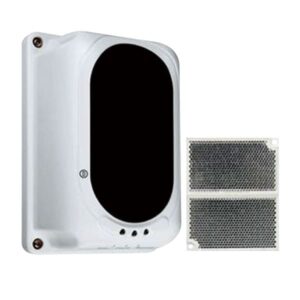
TX7130 reflective beam detector and reflector

TX7130

Detection method
Reflective infrared beam smoke detection
System connection
Native addressable connection to compatible Tanda systems, or fire and fault relays through a compatible input module
Typical project
Open, high-ceiling spaces with a clear optical path, such as warehouses and atriums
TX3190 battery-powered optical smoke alarm

TX3190

Detection method
Battery-powered optical smoke alarm
System connection
Local standalone alarm, or LoRa networking with a compatible wireless base
Typical project
Existing-building retrofits where running new signal cable to detector points is difficult
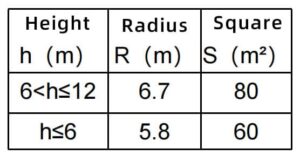
TX7100 Intelligent Smoke Detector Coverage

The coverage range of TX7100 smoke detectors presents two gradients, mainly depending on the installation height:

When the installation height is not higher than 6 meters, the coverage radius is 5.8 meters, and the area is about 60 square meters;

when the height is between 6 meters and 12 meters, the coverage radius is 6.7 meters, and the area is about 80 square meters.

When the height of the building is higher than 8 meters, it is recommended to choose TX7130 infrared beam smoke detector, which is summarized in the following table:

TX7100 smoke-detector-cover-range

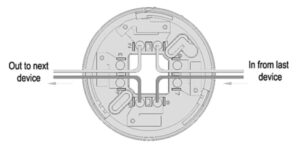
Terminal Description

  1. Signal In (+)
  2. Signal Out (+)
  3. Remote Indicator (+)
  4. Remote Indicator (+)
  5. Signal In (-)
  6. Signal Out (-)
  7. Remote Indicator (-)
  8. Remote Indicator (-)
 

TX7100-smoke-detector-wiring


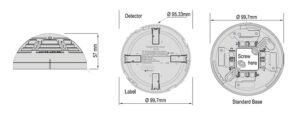
TX7100-smoke-detector-size

TX7100-smoke-detector-size

PRODUCT & TECHNICAL SUPPORT

LPCB Ceiling Mount Smoke Detector FAQs

Frequently asked questions about this product, configuration, compatibility and technical requirements.

01. How does the TX7100 optical smoke detector work?

The TX7100 uses infrared light to detect smoke particles entering its optical chamber. Its onboard processor evaluates the strength of the sensor signal and how quickly it rises. When the signal meets the detector’s alarm criteria, the TX7100 reports the alarm to the fire alarm control panel.

02. Is the TX7100 compatible with the TX7004 fire alarm control panel?

Yes. The TX7100 Installation & Operation Manual identifies the Tanda TX7004 analogue addressable fire alarm control panel as compatible. The detector communicates using the T&A protocol. For any other panel model, confirm compatibility with the manufacturer before specifying the detector.

03. How is a device address assigned to the TX7100?

The V1.2 manual specifies the TX7930 handheld programmer for assigning a device address from 1 to 254. Each device on the loop requires a unique address. The programmer is supplied separately, and the manual instructs commissioning personnel to disconnect the loop connection before attaching it.

04. How do you test the TX7100 smoke detector?

A qualified technician should follow the site’s approved functional test procedure and verify that the connected fire alarm control panel reports the expected detector address. The TX7930 programmer assigns addresses, reads configuration and sets the LED to On or Off. Carry out a functional alarm test separately from those configuration checks.

05. Does the TX7100 smoke detector detect carbon monoxide?

No. The TX7100 detects smoke optically. The TX7120 combines smoke and heat sensing, so a project that requires carbon monoxide (CO) detection needs a device specifically rated for CO detection.

06. What is the operating voltage and current consumption of the TX7100?

The TX7100 is rated at 24 V DC and operates within a 16 to 28 V DC input range. The manual lists current consumption of 0.6 mA in standby and 4 mA in alarm. Use these values when checking the connected load against the compatible panel’s loop limits.

07. What certification and standard are listed in the TX7100 manual?

The TX7100 Installation & Operation Manual V1.2 lists LPCB certification and compliance with EN 54-7:2018, the standard for point smoke detectors. For project submittals, confirm that the certificate covers the exact product variant being supplied.

08. Where should the TX7100 be installed, and when should I consider the TX7130?

The TX7100 is intended for indoor ceiling mounting away from routine steam, condensation, dust and exhaust fumes. Tanda’s product FAQ recommends TX7100 below 8 m and suggests considering the TX7130 beam smoke detector above 8 m. The V1.2 installation manual separately advises against installing the TX7100 above 10.5 m. Confirm detector type, mounting height and spacing for the project.

09. What temperature and humidity range does the TX7100 support?

The TX7100 is specified for operation from −10 °C to +50 °C and from 0 to 95% relative humidity, non-condensing. The non-condensing condition is important when assessing locations with fluctuating temperatures or recurring moisture.

10. Can the TX7100 status LED be disabled?

Yes. The TX7100 has a single LED with 360° visibility. The LED is enabled by default and can be turned off through the detector settings without affecting smoke detection. The manual does not specify a normal-monitoring LED colour or flash interval.

11. Does the TX7100 support a remote indicator?

Yes. The TX7100 provides a remote indicator output for installations that need an indication point separate from the detector. The manual specifies a connecting line of less than 30 m between the detector and the remote indicator. Use the wiring diagram in the installation manual for the terminal assignments.

12. How often should the TX7100 be maintained and tested?

The manual calls for maintenance every three or six months, depending on site conditions, and recommends testing at least every six months in accordance with applicable requirements. It also calls for retesting after the sensing chamber is cleaned and the detector is reinstalled.

13. What should be checked if the TX7100 address does not enrol on the panel?

The TX7100 troubleshooting guide identifies a loose wiring connection and a duplicate device address as possible causes. A qualified technician should check the wiring and verify that the programmed address is unique on the loop before recommissioning the detector.

14. What type of smoke detector is the TX7100?

The TX7100 is an intelligent addressable optical smoke detector that uses infrared light scattering to detect smoke particles. It communicates its status and alarm information to a compatible fire alarm control panel.

15. Which fire alarm standard does the TX7100 comply with?

The TX7100 complies with EN54-7:2018 for point-type smoke detectors operating using scattered light, transmitted light or ionization.

16. Is the TX7100 an addressable smoke detector?

Yes. The TX7100 uses the T&A protocol and supports a programmable address from 1 to 254. Each detector on the same addressable loop must be assigned a unique address.

17. Which fire alarm control panel is the TX7100 compatible with?

The TX7100 is documented for use with the TANDA TX7004 analogue intelligent fire alarm control panel. Compatibility with other control panels or protocols must not be assumed and should be confirmed before ordering.

18. What operating voltage does the TX7100 require?

The TX7100 operates from 16 to 28 VDC, with a nominal input voltage of 24 VDC. Its specified current consumption is 0.6 mA in standby and 4 mA in alarm.

19. Does the TX7100 detect heat or carbon monoxide?

The TX7100 is specified as an optical smoke detector. It must not be treated as a heat detector, carbon monoxide detector or multi-sensor detector.

20. What intelligent detection functions does the TX7100 provide?

The TX7100 includes intelligent signal processing, drift compensation, self-diagnosis and a history memory capable of recording up to 10 events. These functions support detector monitoring but do not replace scheduled inspection and testing.

21. Does the TX7100 have a visible status indicator?

Yes. The TX7100 has a single LED designed to provide 360-degree visual indication. The LED can be configured on or off without disabling the detector's smoke-sensing function.

22. Can the TX7100 connect to a remote indicator?

Yes. The detector base provides a remote indicator output. The connecting line between the detector and remote indicator should be less than 30 metres.

23. What is the maximum ceiling height for installing the TX7100?

The TX7100 should not be installed where the ceiling height exceeds 10.5 metres. Detector quantity, spacing and exact positioning must also comply with the approved fire alarm design and applicable local regulations.

24. What coverage area does one TX7100 provide?

A single fixed coverage-area value has not been confirmed for the TX7100. Detector spacing and coverage must be determined by the approved system design, ceiling configuration, installation conditions and applicable local regulations.

25. Where should the TX7100 not be installed?

Do not install the TX7100 in open-air locations, on side walls, above the permitted ceiling height, or in areas normally exposed to cooking fumes, steam, condensation, exhaust fumes or heavy dust. The selected detector type and location must match the assessed fire risk and local requirements.

26. How is the TX7100 mounted?

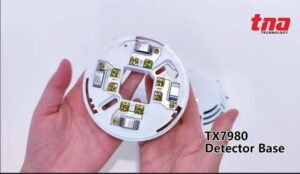
The TX7100 mounts on a T&A standard base installed on a standard one-gang electrical back box. After wiring the base, align the detector with the marked position and rotate it clockwise until it locks securely.

27. What are the dimensions and weight of the TX7100?

The TX7100 measures 99.7 mm in diameter and 57 mm in height. It weighs approximately 145 g with the base and 90 g without the base.

28. What are the operating temperature and humidity limits of the TX7100?

The specified operating temperature is -10°C to +50°C. The permitted relative humidity range is 0% to 95% under non-condensing conditions.

29. Who should install and commission the TX7100?

The TX7100 must be installed and commissioned by qualified or factory-trained fire alarm personnel in accordance with the approved system design, applicable local regulations and the requirements of the relevant fire alarm system.

30. Which handheld programmer is required for the TX7100?

Published TX7100 information references different handheld programmer models. Confirm the programmer model supplied for the selected product version before ordering or commissioning, and do not connect the programmer while the detector remains connected to the addressable loop.

31. How often should the TX7100 be inspected and maintained?

Quarterly or semi-annual maintenance may be used as general manufacturer guidance depending on site conditions. The actual inspection, testing, cleaning and maintenance schedule must follow applicable local regulations and the approved site maintenance plan.

32. How should the TX7100 be cleaned?

Maintenance personnel should disable the detector at the control panel before cleaning it. The exterior can be wiped with a damp cloth, while the sensing chamber and protective screen can be carefully cleaned as required. Do not use chemicals that may leave residue, and reinstall, enable and test the detector after cleaning.

33. What can cause the TX7100 to show a continuous fire signal?

A dirty sensing chamber can cause the detector to continue indicating a fire signal. Qualified maintenance personnel should inspect and clean the chamber, reinstall the detector and complete the required functional testing.

34. What should be checked if the TX7100 address does not enrol?

Check for loose wiring and a duplicated device address. After correcting the wiring or assigning a unique address, recommission the detector in accordance with the approved system procedure.

Free Preliminary System Drawings

Working on a project budget without a system layout? FireMarket provides free preliminary drawings to help you estimate equipment quantities and costs.

Request Free Preliminary Drawings

Related Products