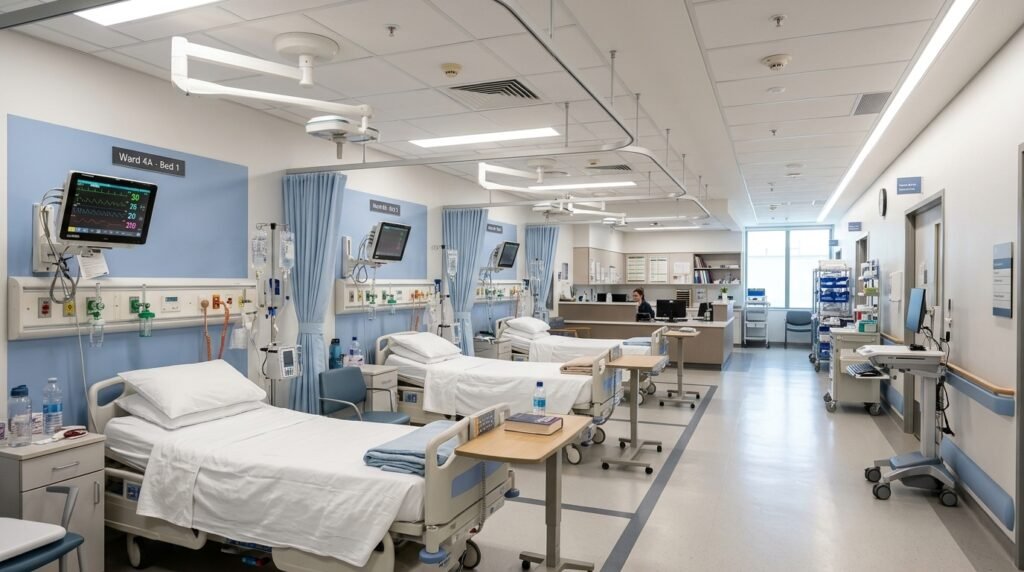
Hospitals are complex environments where patient safety, critical medical equipment, and continuous healthcare services must be protected around the clock. Unlike ordinary commercial buildings, many hospital occupants cannot evacuate independently, and different healthcare areas have their own fire safety requirements. A reliable fire alarm system in hospitals plays an essential role in detecting fires early, alerting medical staff, and supporting a coordinated emergency response, but it takes more than standard detectors and sounders. The system must reflect the specific risks and operational needs of each healthcare area.
This article explores the main fire risks and safety challenges in hospitals, and how fire alarm systems help protect patients and staff through early detection, timely notification, coordinated response, and minimized disruption to medical operations.
Why Fire Safety in Hospitals Requires Special Attention
Common Fire Risks in Hospitals
Fire Safety Challenges in Hospitals
The Role of Fire Alarm Systems in Hospitals
Early Fire Detection in Hospitals’ Critical Areas
Hospitals contain areas where even a small fire can have serious consequences. Patient rooms, intensive care units, operating rooms, laboratories, and electrical rooms may contain medical equipment, electrical systems, or materials that require special fire protection considerations.
Early detection is essential to identify a fire before it spreads to adjacent rooms or affects critical medical activities. In areas requiring highly sensitive detection, aspirating smoke detection systems can provide an additional level of protection. Rather than waiting for smoke to drift up to a ceiling-mounted detector, the unit actively pulls air through a network of sampling pipes and analyzes it for smoke particles. If the reading rises above the configured alarm level, an alert is triggered.
Accurate area identification is also important in hospitals, where multiple patient rooms and clinical spaces may be located close together. With four sampling pipes reported as four independent zones, and a built-in screen for on-site status checks, this model helps staff identify the affected area and respond more precisely.
Timely Alarm and Notification for Hospital Staff and Patients
A fire alarm must do more than detect smoke or heat; it must ensure that the people responsible for responding are alerted in time. In hospitals, this includes clinical staff, maintenance teams, security personnel, and other designated responders.
Sounder strobe devices are particularly important because hospital environments vary considerably. Patients may be asleep, sedated, hearing-impaired, or unable to respond independently. A device that can work as a combined sounder-strobe, a sounder only, or a strobe only gives designers room to match the notification method to each space, for example using sound and light together in corridors and public areas, or visual alerts where audible signals are less effective. With 17 selectable alarm tones, facilities can also choose a tone that suits each area and helps staff recognize the alarm quickly. Clear alarm notification helps staff recognize an emergency and take appropriate action while considering the needs of patients in the affected area.
Supporting Patient Safety and Staff Response
Unlike many other building types, hospitals cannot always rely on immediate evacuation. Patients in intensive care, recovery rooms, or operating areas may depend on life-support equipment or continuous medical supervision. Moving them can require specialist staff, medical equipment, and careful coordination.
A reliable fire alarm system gives hospital teams valuable time to assess the situation and follow the facility’s emergency response procedures. A control panel such as the TX7004 supports this by quickly identifying where a fire has been detected and displaying a custom text message for that location. This is especially useful in hospitals, where wards, ICUs, and operating rooms serve very different functions and staff need to know right away where the alarm has occurred. Depending on the building layout and evacuation strategy, the response may involve moving patients to a safer area within the hospital rather than immediately evacuating the entire building. Through configurable cause-and-effect logic, the panel can also trigger related actions, such as elevator control, air handling shutdown, gas shut-off, and damper control, linking the alarm to the building’s emergency response in line with the facility’s own procedures.
Building Reliable Fire Alarm Systems in Hospitals
Fire safety in hospitals goes beyond standard detection and alarm. Patients who cannot evacuate on their own, complex clinical areas, and round-the-clock operations all call for a system designed around healthcare needs. Well-planned fire alarm systems in hospitals combine early detection in critical areas, notification suited to each space, and clear location information, linked to the building’s wider emergency response. Together, these give medical teams the time and clarity they need to protect patients and keep essential services running.
See how this works in practice with the Cukurova University Hospital Fire Alarm System Project in Turkey, featuring the Tanda TX7004. If you are planning a healthcare fire protection project, contact FireMarket to discuss your requirements and find suitable fire alarm solutions.