Hospital Fire Detection Solutions by Area
Patient Rooms and Wards
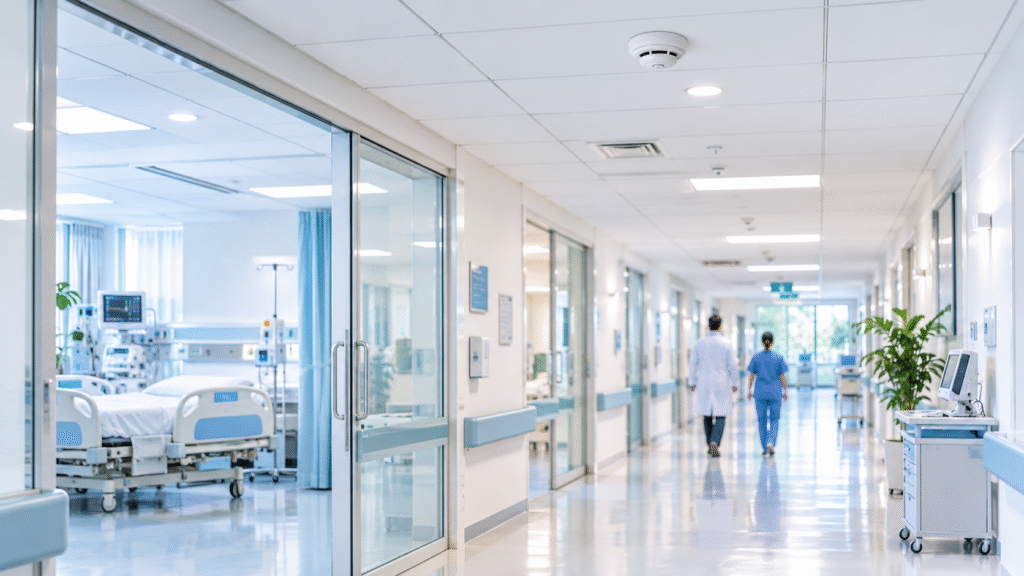
Patient rooms and general wards house patients who may be asleep, recovering, or unable to respond to an emergency on their own. Electrical devices and bedside equipment in these spaces also introduce potential fire risks. Smoke detectors are commonly used in patient rooms and general wards because they can detect smoke during the early development of a fire, often before flames become visible. This provides staff with more time to identify the incident and initiate an appropriate response. Placement matters: ceiling layout and local airflow, including HVAC supply diffusers, light fixtures, and bedside equipment, can redirect smoke or create dead zones, so detectors must be positioned to capture smoke quickly and reliably.
ICUs
ICUs present additional fire safety challenges because they contain life-support equipment and patients who may be sedated, mechanically ventilated, or unable to move or respond to alarms independently. This makes early detection and reliable staff notification particularly important. Alarm signals should reach nursing stations and other designated staff notification points promptly, allowing clinicians to respond when patients cannot act independently.
Operating Rooms
Operating rooms contain high-powered electrical equipment and medical gases, while oxygen-enriched environments can cause fires to develop rapidly. Fire detection systems must therefore provide timely warning while minimizing nuisance alarms that could disrupt surgical procedures. Laminar flow ventilation can carry smoke away from detectors or dilute it, so placement must be coordinated with the airflow design, ceiling layout, and surgical lights and suspended equipment, with each room assessed individually rather than relying on standard spacing.
Emergency Rooms
Emergency rooms mix waiting, triage, treatment, and resuscitation areas with different fire risks, so detection should be zoned, with device types and sensitivity matched to each area’s function. Alarms must also pinpoint the zone of origin clearly and notify responding staff without disrupting ongoing emergency care.
MRI Rooms
MRI scanners generate strong magnetic fields that require careful consideration when selecting fire detection equipment. The use of detectors in MRI environments must take into account not only their external housing materials but also the magnetic properties of their internal components. A non-metallic housing alone does not establish that a detector is suitable for installation near an MRI scanner.
The MRI suite includes different magnetic field zones, such as the scanning room, equipment room, and control room. Detector compatibility and installation locations should therefore be assessed individually and verified against the MRI manufacturer’s safety requirements.
Kitchens
Hospital kitchens contain commercial cooking equipment and sustained heat sources that produce grease aerosols, steam, and airborne particles during normal operation, which can trigger nuisance alarms in smoke detectors. Heat detectors are therefore often more suitable for active cooking areas. The choice between fixed-temperature and rate-of-rise detectors should depend on the kitchen’s normal temperature range, cooking equipment, and ventilation conditions, as rapid temperature changes may cause false alarms with rate-of-rise detectors, while fixed-temperature detectors may respond more slowly to a developing fire.
How to Choose a Fire Alarm System for Hospital Projects
Hospital Fire Alarm System Project Examples
Hospital fire alarm systems must account for different building layouts, clinical functions, and operational requirements. Real-world projects provide practical examples of how fire alarm solutions are applied in healthcare environments.
The following examples feature two hospital projects in different countries: Raja Isteri Pengiran Anak Saleha (RIPAS) Hospital in Brunei and Çukurova University Hospital in Turkey. Both projects involved TANDA addressable fire alarm systems, demonstrating their application in different healthcare settings.
Choosing the Right Fire Alarm System for Hospitals
An effective hospital fire alarm system must be designed around the specific conditions of each area. From detector selection and placement to alarm zoning and system integration, every aspect must support reliable detection while accounting for patient safety and ongoing clinical operations. FireMarket supports fire protection projects through product sourcing and procurement assistance, helping buyers identify suitable solutions for different building requirements.